Table of Contents
No hot water is miserable. Cold showers, dishes piling up, laundry on hold — a water heater not working throws your entire day off. But before you call a plumber and spend $150–$700 on a service visit, there are seven things you can check yourself. Most take less than five minutes. A few might solve the problem entirely.
This guide walks through every check in plain language, tells you which fixes are genuinely safe to DIY, and gives you real cost ranges so you're not going in blind if you do need to call someone. No contractor agenda here — just honest answers.
Don't Panic — Most Water Heater Problems Have Simple Causes
The most common reasons a hot water heater stops working are also the most fixable: a tripped circuit breaker, an extinguished pilot light, a faulty thermocouple, or a thermostat that's drifted out of range. These aren't catastrophic failures — they're normal wear and typically cost $0–$400 to fix, depending on whether you tackle them yourself or call a pro.
Before you start troubleshooting, take two minutes to figure out what type of water heater you have. The checks are slightly different depending on the answer.
Electric vs. Gas Water Heaters — Which Do You Have?
Stand in front of your water heater and look at the top. If you see a metal flue pipe running from the top of the tank up through the ceiling or wall, you have a gas water heater. Gas heaters also typically have a small access panel near the bottom where the burner and pilot light live.
If there's no flue pipe and you see electrical wiring or conduit running to the unit, it's electric. Electric water heaters tend to be simpler-looking — no burner, no pilot light, just a tank with thermostats and heating elements behind small metal panels.
A simple decision tree:
- See a flue pipe on top or a small access panel at the bottom → Gas
- See electrical conduit, no flue pipe → Electric
- Not sure → check your utility bills for a gas line charge, or look for a yellow "Natural Gas" label on the unit
One note: tankless water heaters (the smaller wall-mounted units with no storage tank) exist in both gas and electric versions and have a different troubleshooting process. This guide focuses on standard tank-style water heaters.
Safety First — When to Stop Troubleshooting and Call a Pro Immediately
Most water heater problems are minor. But a few situations require you to stop what you're doing and call a professional right now — not because the repairs are too complex, but because the stakes are serious.
Stop and call immediately if:
- You smell rotten eggs or sulfur near the water heater. That's the odorant added to natural gas. Get everyone out of the house, leave the door open, and call your gas company from outside. Don't flip any light switches until you're clear.
- Water is actively pooling at the base of the tank. Shut off the cold water supply valve (on the pipe above the tank — turn it clockwise until it stops), then call a plumber.
- You hear a high-pitched screaming or screeching noise coming from the unit. Turn it off immediately. This can indicate dangerous pressure buildup inside the tank.
- The pressure relief valve is spraying water or steam. Do not touch it. Call a plumber immediately.
These situations are rare. If none of them apply to you, keep reading — your problem is very likely one of the seven things below.
7 Things to Check Before Calling a Plumber
1. Check Your Circuit Breaker or Gas Supply
Difficulty: Easy | Time: 3 minutes | DIY Cost: $0 | Pro Cost: $0–$200
This is always the first check, and it solves the problem more often than you'd expect.
For electric water heaters: Your electrical panel is usually in a utility room, basement, garage, or hallway — a gray metal box mounted on the wall. Open the door and look for the breaker labeled "Water Heater." A tripped breaker doesn't look fully "off" — it sits at a halfway position between ON and OFF. To reset it: push the breaker firmly all the way to the OFF position first, then flip it back to ON. Give the water heater 30–60 minutes to heat up, then check for hot water.
For gas water heaters: Find the gas shutoff valve on the supply line running to the bottom of the tank. The valve handle should be parallel to the pipe to be open. If it's perpendicular (turned sideways), the gas is shut off. Turn it parallel to open it. Also check that other gas appliances in your house are working — if nothing lights anywhere, call your gas company.
When to call a pro: If the breaker won't reset or trips again within minutes of resetting, there's an underlying electrical problem — don't keep resetting it. Call an electrician. If you smell gas when checking the valve, follow the safety steps above.
2. Inspect the Pilot Light (Gas Water Heaters Only)
Difficulty: Easy–Moderate | Time: 10–45 minutes | DIY Cost: $0–$20 | Pro Cost: $100–$325
If you have a gas water heater and no hot water, check the pilot light. Find the small access panel near the bottom of the tank. A healthy pilot light is a small, steady blue flame. No flame means the pilot is out.
How to relight the pilot:
- Turn the gas control knob to "Off." Wait a full 5 minutes to let any residual gas clear — don't skip this step.
- Turn the knob to "Pilot."
- Press the knob down while pressing the red igniter button (or use a long match). Keep holding the knob down throughout.
- Once the pilot lights, keep holding the knob down for a full 30–60 seconds. This heats the thermocouple so it registers the flame. Let go too soon and the pilot dies immediately.
- Release the knob slowly. The pilot should stay lit.
- Turn the knob to "On" and set your desired temperature. Give it 30–60 minutes to reheat.
If the pilot won't stay lit after you release the knob, the thermocouple is almost certainly the problem. It's a small copper sensor rod that sits in the pilot flame — when it fails, the gas valve shuts off as a safety measure even when the flame is burning. Replacing a thermocouple costs $10–$20 for the part and about 30–45 minutes of work for someone comfortable with basic tools.
When to call a pro: If the pilot won't light after three attempts. If you smell gas at any point. If the thermocouple looks corroded or is hard to access. A plumber will charge $100–$325 for this repair, which covers the part, labor, and warranty on the work.
3. Test the Thermostat Setting
Difficulty: Easy–Moderate | Time: 5 minutes to check; 2–4 hours to confirm | DIY Cost: $0–$50 | Pro Cost: $150–$550
Sometimes the answer really is this simple: someone turned the thermostat down and the water is heating — just not to the temperature you expect.
On electric water heaters, thermostats are behind small access panels on the side of the tank. On gas heaters, the temperature dial is on the front of the gas control valve. The U.S. Department of Energy recommends 120°F as the standard setting for most households. Never set it above 140°F — scalding risk increases significantly above that threshold.
Set the temperature noticeably higher than its current setting, then listen. For electric, you should hear a click as the heating element activates. For gas, the burner should ignite within a minute or two. If nothing happens, the thermostat is likely faulty.
When to call a pro: If adjusting the temperature triggers no response. If the thermostat is integrated into the gas control valve (common on newer gas heaters). Electric thermostat replacement is manageable for someone comfortable with basic wiring after shutting off the breaker; gas valve thermostats are a professional repair.
4. Look for Visible Leaks
Difficulty: Easy to inspect; Moderate to fix | Time: 5 minutes to inspect | DIY Cost: $0–$30 | Pro Cost: $100–$2,500+
Walk all the way around your water heater and look for puddles, drips, damp spots, or water stains. Where the water is coming from determines whether this is a $0 fix or a full replacement.
- Top connections (cold water inlet and hot water outlet pipes): A drip here is usually a loose fitting. Turn off the cold water supply valve above the tank, then try tightening with a pipe wrench. Cost: $0 DIY, $100–$150 for a plumber.
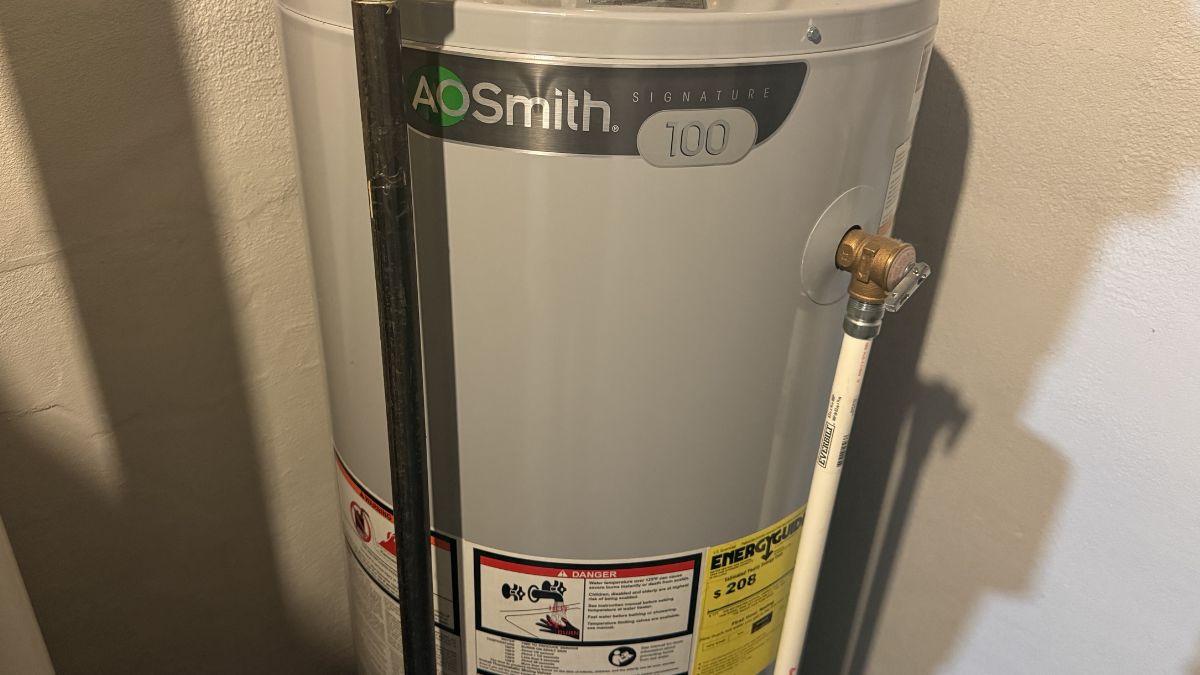
- Pressure relief valve (side or top of tank): A drip from this safety valve means it's worn out or your water pressure is too high. Don't ignore it. Replacement valve: $15–$30 for the part, $150–$300 with a plumber.
- Bottom of the tank itself: This is not a repair — it's a replacement. A tank leaking from its body has corroded from the inside out. No patch holds under constant water pressure. You need a new water heater.
When to call a pro: If water is actively flowing or gushing. If the leak is from the tank body. If you see significant corrosion around fittings. Tank replacement always requires a professional — it involves plumbing, gas or electrical connections, and typically permits.
5. Check the Pressure Relief Valve
Difficulty: Moderate | Time: 5 minutes to test; 45–60 minutes to replace | DIY Cost: $15–$30 | Pro Cost: $150–$300
The pressure relief valve sits on the side or top of the tank with a pipe running down toward the floor. Its job is to automatically release pressure if the tank overheats. If it fails, an overpressurized tank can be seriously dangerous — this is one component not to overlook.
How to test it:
- Place a small bucket under the discharge pipe.
- Carefully lift the lever on the valve for two or three seconds.
- Water should rush out through the pipe, then stop cleanly when you release the lever.
If no water comes out, the valve may be stuck or corroded — a safety concern. If water keeps dripping after you release the lever, the valve needs to be replaced. A replacement costs $15–$30 for the part; a plumber will charge $150–$300.
When to call a pro: If the valve is already actively spraying steam or water — do not approach it, call immediately. If you're not comfortable draining the tank and working with threaded pipe fittings.
6. Flush Sediment Buildup
Difficulty: Easy–Moderate | Time: 30–45 minutes | DIY Cost: $0 | Pro Cost: $100–$250
If your water heater is making a popping, rumbling, or cracking noise when it heats — like a pot of water boiling with gravel at the bottom — that's sediment. Minerals dissolved in your water gradually settle at the bottom of the tank and insulate the heating element, forcing it to work harder and longer. Left alone, it causes the element to overheat and fail — a $200–$400 repair that's completely avoidable.
How to flush the tank:
- Turn off power — flip the circuit breaker (electric) or turn the gas valve to "Pilot" (gas).
- Turn off the cold water supply valve above the tank.
- Connect a standard garden hose to the drain valve at the bottom of the tank. Run the hose outside or to a floor drain.
- Open a hot water faucet somewhere in the house to break the vacuum inside the tank.
- Open the drain valve and let 2–3 gallons flow out.
- Check the water: clear is good; rusty, brown, or chunky means significant sediment buildup.
- Close the drain valve, restore the cold water supply, close the faucet once water runs clear, then restore power.
Do this annually as preventive maintenance and your water heater will last significantly longer.
When to call a pro: If the drain valve is corroded and won't turn — don't force it. If the water coming out is rusty and the tank is 8+ years old, flushing alone may not save it.
7. Assess the Age of Your Water Heater
Difficulty: Easy | Time: 5 minutes | DIY Cost: N/A
This isn't a repair — it's a reality check. A 12-year-old water heater that stops working is telling you something different than a 3-year-old one.
Find the manufacturer's label on the side of the tank. The serial number encodes the manufacture date — but the format varies by brand:
- A.O. Smith: The first two digits of the serial number are the year (e.g., "19" = 2019).
- Rheem: Uses a letter-based year code in the serial number. Check Rheem's support page for the full chart.
- Bradford White: Year is encoded by letter. Their website has a serial number decoder tool.
Standard tank-style water heaters last 8–12 years. Tankless units can last 15–20 years. If your tank is past 10 years old and something has gone wrong, use this math:
The 50% Rule: If the repair quote exceeds 50% of what a new tank would cost, AND your current tank is 8+ years old, replacing it is almost always the smarter financial move. You'll get a new unit with a 6–10 year warranty instead of patching an old one that's statistically likely to develop another problem within 1–2 years.
A new 40–50 gallon tank-style water heater installed runs $882–$2,500 on average, with most homeowners paying around $1,200–$1,800 for a straightforward swap. Tankless units run higher — $1,400–$4,500 depending on type and whether your home needs electrical or gas line upgrades.
Water heater replacement is always a professional job. It involves plumbing, gas or electrical connections, and permits in most jurisdictions.
Not sure which of these is your problem?
Add a few photos, describe your symptoms, and Match2Fix tells you what's likely wrong — in 30 seconds, with no sales pitch and no spam.
Get Your Free Diagnosis →DIY Fix or Professional Repair? Here's How to Decide
Knowing what's wrong is half the battle. The other half is being honest with yourself about what you're comfortable tackling. Here's a clear breakdown.
Repairs Most Homeowners Can Handle Themselves
| Repair | Difficulty | Time | Parts Cost | Skills Required |
|---|---|---|---|---|
| Reset circuit breaker | Easy | 2 min | $0 | None — just find the panel |
| Relight pilot light | Easy | 10 min | $0 | Comfortable near a gas appliance |
| Adjust thermostat setting | Easy | 5 min | $0 | None |
| Flush sediment | Easy–Moderate | 45 min | $0 | Comfortable with valves and hoses |
| Replace thermocouple | Moderate | 30–45 min | $10–$20 | Basic tools, following instructions |
| Tighten leaking connections | Moderate | 15 min | $0 | Pipe wrench, water shutoff knowledge |
| Replace pressure relief valve | Moderate | 45–60 min | $15–$30 | Basic pipe threading skills |
If you've ever assembled furniture, replaced a faucet, or done any basic home repair, the "Easy" and "Moderate" repairs on this list are within your reach. If you've genuinely never done any home repair, stick to the "Easy" column and call someone for the rest. There's no shame in knowing your limits — the whole point is getting your hot water back, not proving something.
Repairs That Require a Licensed Plumber (and Why)
| Repair | Why It Needs a Pro | Typical Cost |
|---|---|---|
| Heating element replacement (electric) | Requires draining tank, electrical work in a wet environment | $200–$400 |
| Gas control valve replacement | Involves gas line work, specific tools and certifications | $150–$550 |
| Pressure relief valve (if corroded/stuck) | Safety-critical; stuck valve requires careful removal | $150–$300 |
| Full tank replacement | Plumbing + electrical or gas connections + permits | $882–$2,500 |
| Expansion tank issues | Requires understanding of pressure system dynamics | $200–$400 |
These aren't labeled "pro repairs" because they're impossibly complex — they're pro repairs because they involve safety-critical components, specialized tools, or local permit requirements.
What a Water Heater Service Call Typically Costs
Having realistic cost expectations protects you from being overcharged:
- Diagnostic visit: $75–$150 (often credited toward the repair if you proceed)
- Minor repairs (thermocouple, pressure valve, thermostat): $100–$450
- Major repairs (gas control valve, heating element): $150–$700
- Full tank replacement, installed: $882–$2,500 for standard tank; $1,400–$4,500 for tankless
- Emergency or after-hours surcharge: Add $100–$300 on top of any of the above
If a plumber quotes you $600 to replace a thermocouple — a $15 part that takes 30 minutes to swap — that's a red flag. Understanding what each repair actually involves is the only way to spot inflated quotes.
How to Avoid Overpaying for Water Heater Repair
The founder of Match2Fix used the app to research what a water heater replacement should actually cost for her specific unit — and when the first quote came in, she knew immediately it was too high. She saved over $1,000 by having that number before the conversation started.
When you know what your repair should cost, you can evaluate whether a quote is fair. That's exactly the problem Match2Fix was built to solve.
Red Flags in a Contractor's Quote
- No itemized breakdown. A reputable contractor can tell you: here's the part, here's what it costs, here's the labor.
- Pressure to decide on the spot. "I can only offer this price today" is a sales tactic, not a plumbing reality.
- Tank replacement recommended for a clearly minor problem without a clear explanation of why repair isn't viable.
- Quote is significantly higher than others with no explanation. Two or three estimates should be in a similar ballpark. A quote that's 3–5x higher demands justification.
- Can't explain what's wrong in plain language. If a contractor can't tell you what failed and why, they either don't know or they're hoping you won't ask.
Why Quotes for the Same Job Can Vary by 5x
Water heater repair pricing isn't standardized. Contractors price based on their overhead, their market, how busy they are, and sometimes — frankly — how much they think they can charge. That's not always malicious; it's just the reality of an unregulated service market.
The defense against it is knowledge. If you know the problem is a bad thermocouple (a $15–$20 part that takes 30–45 minutes to replace), you can evaluate a $600 quote very differently than if you have no idea what's wrong. Understanding your problem before anyone shows up with a price turns you from a customer in the dark into an informed homeowner who can ask the right questions and push back when something doesn't add up.
Get diagnostic clarity before you call anyone
Match2Fix tells you what's likely wrong with your water heater in 30 seconds — so you can walk into every contractor conversation informed. No spam, no sales pitch, no contractor kickbacks. Just honest answers.
Try Match2Fix Free →Frequently Asked Questions
How long does a water heater last?
Standard tank-style water heaters typically last 8–12 years. Tankless water heaters can last 15–20 years with proper maintenance. The biggest factors affecting lifespan are water hardness (hard water accelerates sediment buildup and corrosion), how consistently the tank is flushed and maintained, and the quality of the original installation.
Can I replace a water heater myself?
Technically yes, but it's not recommended unless you have significant plumbing and electrical or gas experience. Most jurisdictions require a permit for water heater replacement, and a permitted installation will be inspected for code compliance. An improperly installed water heater can leak, cause a gas leak, create an electrical hazard, or void the manufacturer's warranty. The $500–$1,000 you'd save on labor isn't worth those risks for most homeowners.
Why is my water heater making a popping or rumbling noise?
Almost always sediment. Mineral deposits from your water supply settle at the bottom of the tank over time. When the heating element tries to heat water through that layer, it causes trapped water underneath to boil and pop — that's the noise you're hearing. The solution is flushing the tank (see Step 6 above). If the noise persists after a thorough flush, the heating element may be failing and need replacement.
How much does it cost to replace a water heater?
For a standard tank-style unit installed by a professional, most homeowners pay between $882 and $2,500, with an average around $1,337. Electric tank heaters are typically on the lower end of that range; gas heaters run slightly higher. Tankless water heaters cost significantly more upfront — $1,400–$4,500 installed — but last longer and use less energy. Get at least three quotes, and make sure each one includes labor, the unit, and any permit fees.
Is it worth repairing an old water heater?
Use the 50% rule: if the repair quote exceeds 50% of what a new tank would cost, and your current tank is 8+ years old, replace it. Example: your tank is 10 years old and repair is quoted at $900. A new tank installed runs about $1,500. You'd be spending 60% of replacement cost on a decade-old tank with no warranty. Spending $1,500 now for a fresh unit with a 6–10 year warranty is the better financial call.
What's the most common reason a water heater stops working?
For electric water heaters, the most common culprits are a tripped circuit breaker or a failed heating element. For gas water heaters, it's usually a pilot light that's gone out or a bad thermocouple. The good news: both a reset breaker and a relighting pilot are $0 fixes you can do yourself in minutes. A failed heating element or thermocouple runs $100–$400 to fix — still a minor repair in the scheme of things.
How do I know if my water heater is leaking?
Look for puddles or damp spots on the floor around the base of the tank, water stains on the tank exterior or the floor nearby, rust on the tank or connections, or a dripping sound when the heater is quiet. If you find water, trace it carefully — a drip from the top connections may be a loose fitting (potentially a DIY fix), while water coming from the tank body itself means the tank needs to be replaced.
Should I turn off my water heater when I go on vacation?
Yes, if you'll be gone for more than a week. For a gas water heater, turn the gas valve to "Vacation" mode — most modern gas heaters have this setting, which keeps the pilot lit but uses minimal gas. For an electric heater, switch off the circuit breaker. In either case, turning off the cold water supply valve to the tank provides extra insurance against a slow leak while you're away.
Get instant answers about your home repairs
Upload photos, describe your issue, and get a detailed diagnostic in 30 seconds.
Try Match2Fix Free

