Table of Contents
A clogged drain that won't clear with a plunger is frustrating, but it's usually fixable without calling a plumber — if you use the right approach in the right order. The mistake most people make is jumping straight to chemical drain cleaners, which often don't work, can damage pipes, and leave you with the same clog plus a pipe full of corrosive liquid to deal with.
This guide walks through a four-step escalation — from free to moderate cost, easy to slightly involved — that clears the vast majority of residential drain clogs. It also tells you the specific signs that mean your clog isn't a clog at all, but a sewer line problem that genuinely needs a professional.
Simple Clog or Sewer Line Problem? How to Tell
Before you try anything, spend two minutes figuring out which situation you're actually in. The fix is completely different.
Signs It's a Simple Clog (One Drain)
A simple clog is localized — it's sitting in the drain, the P-trap, or the branch line serving one fixture. Signs:
- Only one drain is slow or backed up
- Other drains in the house are working normally
- No gurgling sounds from other drains when this one runs
- No sewage smell from other fixtures
- The problem developed gradually (slow drain getting slower over time)
This is the scenario the four-step approach below is designed for. Most single-drain clogs can be cleared DIY in under an hour.
Signs It's a Main Sewer Line Problem
The main sewer line is the single pipe that carries wastewater from every drain in your home to the municipal sewer or septic system. When it's blocked, multiple drains back up simultaneously because there's nowhere for water to go. This is not a DIY situation — it requires a plumber with a power auger or hydro-jetting equipment.
Stop and call a plumber if you notice any of these:
- Multiple drains are slow or backed up at the same time — especially if the toilet, sink, and shower are all affected
- Flushing the toilet causes water to back up into the bathtub or shower — this is a classic main line symptom and means sewage has nowhere to go except back into your home
- Gurgling sounds from drains you're not using — running the kitchen sink causes gurgling in the bathroom drain, for example
- Sewage smell from floor drains or multiple fixtures
- Water backing up into the lowest drain in the house — typically a basement floor drain or ground-floor toilet
- Raw sewage visible in the cleanout cap — the cleanout is a white or black capped pipe, typically in the yard, basement, or garage
A main sewer line backup is a health hazard — raw sewage in your home carries bacteria and pathogens. Don't run any water in the house until it's cleared. Skip to the plumber cost section below for what to expect to pay.
The 4-Step Escalation Approach
Work through these in order. Each step is more involved than the last — but so is the clog if you've gotten that far. Most clogs clear at Step 1 or 2.
Step 1: Boiling Water and Dish Soap
Difficulty: Easy | Time: 10 minutes | Cost: $0
This works remarkably well on grease clogs — the most common type in kitchen sinks. Dish soap breaks up grease, and very hot water carries it down the drain.
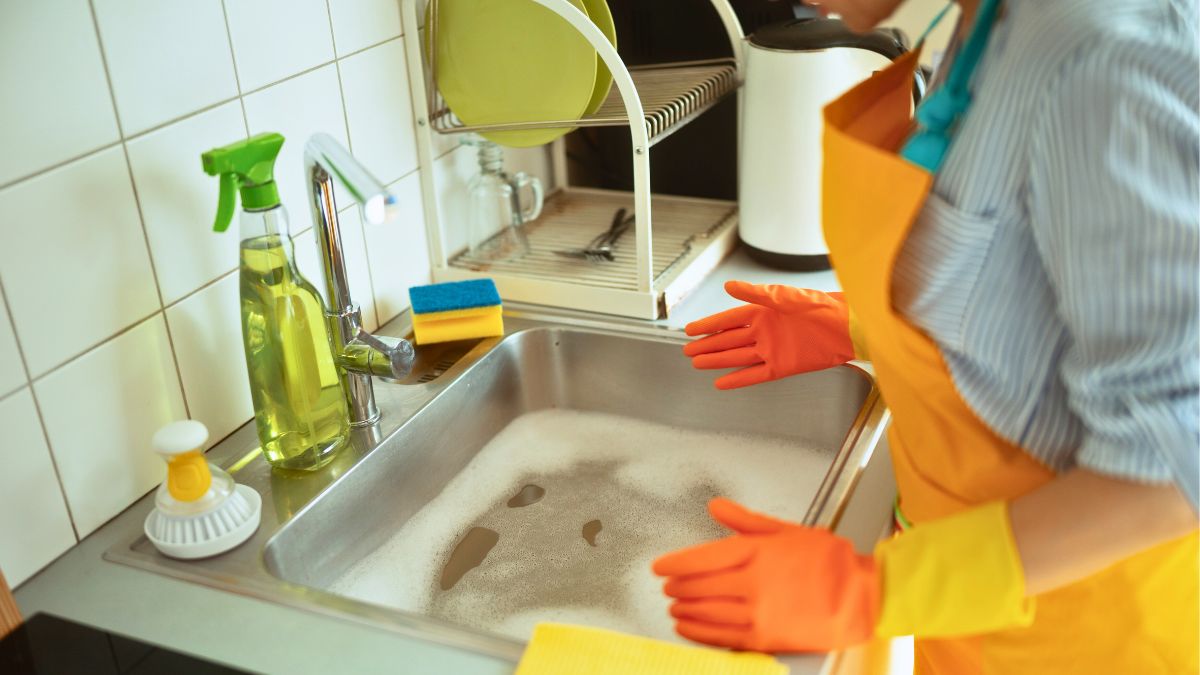
Squirt a generous amount of dish soap directly into the drain. Boil a full kettle of water (or as close to boiling as possible — this needs to be hotter than what comes from your tap). Pour it slowly in two or three stages, waiting 30 seconds between each pour. The hot water melts grease buildup and the soap helps it flow through.
Important caveat: Don't use boiling water on PVC pipes — the extreme heat can soften and warp the fittings over time. If your home was built after the 1990s, your drain lines are almost certainly PVC. Use the hottest water from your tap instead, or heat water to just below boiling. Older homes with cast iron or copper drain lines can handle boiling water without issue.
Not sure what type of pipes you have? Look under the sink — PVC pipes are white or gray plastic; copper is obviously copper-colored; cast iron is dark gray-black and heavy-looking. When in doubt, use hot tap water rather than boiling.
If this doesn't clear it fully, move to Step 2 immediately rather than pouring more boiling water. Repeated attempts won't help if the clog is hair or solid debris rather than grease.
Step 2: Baking Soda and Vinegar Flush
Difficulty: Easy | Time: 20–30 minutes | Cost: $3–$5
This is the old standby — and it genuinely works on partial clogs and buildup, though it's not magic. The fizzing reaction between baking soda (a base) and white vinegar (an acid) creates agitation that can break up soft buildup and move a partial clog.
- Pour one cup of baking soda directly into the drain. Use a spoon to push it past the drain cover if needed.
- Follow immediately with one cup of white vinegar.
- Cover the drain opening with a stopper or a rag pressed firmly down — you want the fizzing action to work downward into the clog, not bubble up out of the drain.
- Wait 15–20 minutes.
- Flush with the hottest water from your tap (or boiling water if you have metal pipes) for a full minute.
You can repeat this once more if it partially helps but doesn't fully clear. If the drain is still slow or blocked after two attempts, the clog is solid enough that chemistry won't move it — time for Step 3.
Step 3: Plunger — But the Right Way
Difficulty: Easy | Time: 10–15 minutes | Cost: $8–$20 if you need a new one
You've tried plunging — but there are two common mistakes that cause plunging to fail even when the clog is plungeable.
Mistake 1: Using the wrong plunger. The red cup plungers most people have are designed for flat sink drains. For toilets, you need a flange plunger — one with a rubber flap that folds out from the bottom of the cup, designed to seal the curved toilet opening. Using a flat cup plunger on a toilet is ineffective because you can't get a seal. A flange plunger works on both sinks and toilets.
Mistake 2: Not sealing other openings. In a double kitchen sink, block the other drain opening with a wet rag before plunging. In a bathroom sink, block the overflow hole — the small opening near the top rim of the sink — with your finger or a rag. Without a seal on these openings, air pressure escapes and plunging does nothing.
The correct technique:
- Add enough water to the sink or tub to cover the plunger cup — you're moving water, not air, and you need the cup submerged.
- Seal the plunger over the drain and press down slowly to expel air from the cup before you start.
- Plunge with firm, even strokes — straight up and down. Don't break the seal between strokes.
- After 15–20 strokes, pull the plunger up sharply to break the seal. This suction action is often what actually dislodges the clog.
- Run water to see if it drains. Repeat 2–3 times before concluding the plunger isn't working.
Step 4: Drain Snake (Hand Auger)
Difficulty: Moderate | Time: 20–45 minutes | Cost: $25–$50 to buy; $0 if you borrow or already own one
A drain snake — also called a hand auger or plumber's snake — is a flexible coiled cable that you feed into the drain to physically break up or hook a clog and pull it out. This is what clears the clogs that chemistry and plunging can't touch: a solid mass of hair, a small object that went down the drain, or buildup deep in the P-trap or branch line.
You can buy a basic hand auger at any hardware store for $25–$50, and it's worth having in the house. The alternative is calling a plumber for a job this tool handles in 20 minutes.
How to use it:
- Remove the drain stopper or strainer if possible — most bathroom sink stoppers can be lifted out or unscrewed.
- Feed the end of the cable into the drain opening by hand until you feel resistance.
- Tighten the thumbscrew on the handle to lock the cable, then rotate the handle clockwise while pushing forward gently. The rotation is what lets the cable navigate the pipe bends — don't just push.
- When you hit the clog, you'll feel increased resistance. Work the cable back and forth with short strokes while continuing to rotate — you're either breaking the clog up or hooking it.
- Pull the cable back out slowly. Have paper towels ready — whatever was clogging the drain is coming out with it.
- Run hot water for a full minute to flush any remaining debris.
For bathroom sinks: The clog is almost always a hair-and-soap-scum mass sitting right in the P-trap, usually within the first foot or two of drain line. The snake reaches it easily.
For kitchen sinks: Grease clogs can be further down the line. Feed the snake past the P-trap (which you'll feel as a tight bend) and continue another foot or two.
For tubs and showers: Access the drain by removing the overflow plate (the small cover above the drain on the tub wall, held by one or two screws) and feed the snake in through there rather than the drain itself — you'll get a straighter shot at the clog.
If the snake hits something that won't break up and won't come out after several attempts, stop. You may be dealing with a more significant blockage, a collapsed pipe section, or tree root intrusion — none of which a hand auger can clear. This is where a plumber's power auger or hydro-jetting becomes necessary.
Not sure what's causing your drain problem?
Add a few photos, describe your symptoms, and Match2Fix tells you what's likely going on — in 30 seconds, with no sales pitch and no spam.
Get Your Free Diagnosis →Clogs by Location — What Works Where
Different drains have different common culprits, and the most effective approach varies by location.
Kitchen Sink
Most common cause: Grease and food particle buildup. Grease poured down the drain when it's liquid solidifies as it cools further down the pipe, gradually narrowing the line until it blocks completely. Coffee grounds, rice, and pasta are also frequent contributors — they compact into a dense mass that water can't move.
Best approach: Start with Step 1 (hot water and dish soap) since this is almost always a grease clog. If that doesn't work, go straight to the drain snake — baking soda and vinegar is less effective on dense grease buildup than on hair clogs.
Double-sink note: If you have a garbage disposal, check that it's not the source of the problem. Run it with cold water flowing to clear any food that's packed up in the disposal itself before assuming the drain is clogged.
Bathroom Sink
Most common cause: Hair and soap scum accumulating around the drain stopper and in the P-trap. This builds up slowly and creates a dense, matted mass that plunging alone often can't dislodge because the hair fibers grip the pipe walls.
Best approach: Before anything else, pull out the drain stopper and clean it — the stopper itself is often coated in the clog. Most bathroom sink stoppers lift straight out, or have a small pivot rod underneath that you can disconnect by reaching under the sink and loosening the clip on the horizontal rod. Once the stopper is out, use a zip-it tool ($3–$5, also called a drain cleaning tool — a long flexible plastic strip with barbs) to pull out the hair mass. This is often faster and more effective than any of the four steps above for bathroom sinks specifically.
Shower and Tub Drain
Most common cause: Hair, exactly as in bathroom sinks — but in larger volume since shower drains catch more of it. The clog typically sits just below the drain strainer or a few inches into the pipe.
Best approach: Remove the drain cover (usually just pops off or has one screw) and use a zip-it tool or needle-nose pliers to pull out the hair mass before trying anything else. You'll be amazed how much hair can accumulate — and pulling it out physically is more effective than any chemical or flush method. If the drain is still slow after clearing visible hair, use the snake through the overflow plate as described in Step 4.
Toilet
Most common cause: Excess toilet paper, "flushable" wipes (which are not actually flushable — they don't break down like toilet paper), or a foreign object. Toilets rarely clog from buildup like sinks do; it's almost always something that shouldn't have been flushed.
Best approach: Use a flange plunger — not a flat cup plunger. For persistent clogs, a toilet auger (also called a closet auger, $20–$30) is specifically designed for toilets and has a protective rubber sleeve that prevents the cable from scratching the porcelain bowl. If the toilet is completely blocked and won't respond to plunging or augering, the clog may be beyond the toilet trap — in the main drain line — and will need a plumber.
What NOT to Do — Common Mistakes That Make It Worse
Don't Use Chemical Drain Cleaners
This is the most important one. Products like Drano and Liquid-Plumr contain sodium hydroxide (lye) or sulfuric acid. Here's the problem: they work by generating heat to dissolve the clog — but that same heat and caustic chemistry also attacks your pipes over time, particularly PVC fittings, rubber seals, and older metal pipes. They're also genuinely dangerous to handle; contact with skin or eyes causes chemical burns.
More practically: they often don't fully clear the clog, they just partially dissolve it and push it slightly further down. Now you have a clog AND a drain full of corrosive liquid that a plumber has to deal with safely — which means you've made the professional visit more complicated and expensive.
The one narrow exception: enzyme-based drain cleaners (not the acid or lye-based ones) are genuinely safe for pipes and work well as a preventive monthly treatment to break down organic buildup before it becomes a clog. They won't clear an existing blockage, but they're worth using after you've cleared one to keep the pipe flowing.
Don't Force the Snake
A hand auger should navigate drain bends with light rotating pressure. If you're meeting hard resistance, forcing the cable can punch through old pipe walls (especially in older cast iron drains), push a clog further into the line where it's harder to reach, or jam the cable in the pipe. When you hit resistance, rotate while backing off gently — let the rotation do the work.
Don't Ignore a Slow Drain
A slow drain is a clog in progress. It's infinitely easier to clear a partial clog than a fully blocked one. The monthly baking soda and vinegar flush takes five minutes and can prevent a $150–$300 plumber visit. If a drain is consistently slower than it should be, address it before it stops entirely.
Don't Run Water Into a Fully Blocked Drain
If a drain is completely blocked, running water into it just fills the pipe until it overflows. If you have a complete blockage, stop running water in that fixture until you've made progress clearing it.
When to Call a Plumber — And What It Will Cost
Call a plumber when:
- Multiple drains are affected (main sewer line problem)
- The four-step approach hasn't cleared a single-drain clog
- You notice sewage smell from multiple fixtures
- Water is backing up into other fixtures when you run one
- The clog keeps coming back within days or weeks of clearing it (indicates a recurring cause — root intrusion, a broken pipe, or a gradual collapse in the line)
- You suspect something structural — gurgling that persists after clearing, or a drain that has never flowed properly despite clearing attempts
What You Should Expect to Pay in 2026
- Service call / diagnostic fee: $50–$200 (often credited toward the repair if you proceed)
- Single drain clearing — snake/auger: $100–$275 for a sink, tub, or toilet
- Main sewer line snake/auger: $200–$500
- Hydro-jetting (main line): $600–$1,400 depending on severity and line length
- Sewer camera inspection: $125–$500 (some plumbers include it free with a main line clearing)
- Emergency / after-hours service: Often 2–3x standard rates — $135–$190 per hour instead of $45–$150
- Pipe repair or replacement (if the clog reveals a broken pipe): $100–$350 for a section; $2,000–$10,000 for full sewer line replacement
Snaking vs. Hydro-Jetting — What's the Difference?
A plumber's power auger (snake) is the starting point for most clogs — it physically breaks up or pulls out the blockage. It's faster and cheaper, and it resolves the majority of drain problems.
Hydro-jetting uses a high-pressure water stream (4,000–35,000 PSI) to scour the pipe walls clean, not just punch through the clog. It's more thorough, costs more, and is typically recommended for recurring clogs, significant grease buildup in main lines, or root intrusion that snaking can't fully clear. When a plumber recommends hydro-jetting on the first visit for a straightforward clog, it's worth asking why snaking isn't sufficient first.
Red Flags in a Plumbing Quote
- Hydro-jetting recommended immediately for a single-drain clog without attempting to snake it first. Snaking is almost always the right first step and costs significantly less.
- Pipe replacement recommended based on a clog alone, without a camera inspection to confirm damage. A recurring clog doesn't always mean a broken pipe — it can mean a partial obstruction that needs more thorough clearing.
- No itemized breakdown. You should see the service call fee, the method being used, and the labor separately. If a plumber won't break this out, ask specifically.
- Pressure to authorize full sewer line replacement on the same visit as the diagnosis. A legitimate plumber will show you camera footage of any damage before recommending replacement. "Trust me, it needs to be replaced" is not sufficient.
- Quote is dramatically higher than the ranges above with no explanation. For any repair over $500, get a second opinion.
Get diagnostic clarity before you call anyone
Match2Fix tells you what's likely going on with your drain in 30 seconds — so you can walk into every plumber conversation informed. No spam, no sales pitch, no contractor kickbacks. Just honest answers.
Try Match2Fix Free →How to Prevent Clogs From Coming Back
Most residential drain clogs are preventable. These habits cost almost nothing and eliminate the majority of plumbing service calls:
- Install drain strainers in every tub and shower. A $4 mesh strainer catches the hair before it enters the pipe. Clean it weekly. This single habit prevents the most common residential drain clog entirely.
- Never pour grease down the kitchen drain. Pour cooled grease into a container and throw it in the trash. Wipe greasy pans with a paper towel before washing. Even with hot water running, grease eventually solidifies somewhere in the line.
- Run cold water when using the garbage disposal, not hot. Cold water keeps grease solid so it can be chopped and flushed through; hot water liquefies it so it coats the pipe walls further down.
- Don't flush anything but toilet paper. "Flushable" wipes, paper towels, cotton balls, feminine hygiene products, and dental floss don't break down in the pipe and are a leading cause of main line blockages.
- Monthly preventive flush: Baking soda and vinegar down every drain once a month, followed by hot water. Takes five minutes, costs pennies, and keeps light buildup from becoming a clog.
- Have your main sewer line inspected if your home is more than 20 years old and you've never had it done. Tree roots are the leading cause of main sewer line failure, and a camera inspection ($125–$500) catches root intrusion before it causes a backup.
Frequently Asked Questions
Why won't my drain clear even after plunging?
Plunging works on clogs close to the drain opening that can be dislodged by pressure. If the clog is a dense hair mass gripping the pipe walls, a solid object, or a buildup of grease deep in the line, plunging won't move it. Work through the four steps: try the baking soda and vinegar flush, then the drain snake. For bathroom sink clogs specifically, check whether the stopper itself is coated in hair and soap residue — cleaning the stopper often resolves what seems like a stubborn clog.
Is Drano safe to use?
Occasionally, on a healthy drain, Drano and similar products won't cause immediate damage. But regular use damages pipes — particularly PVC fittings, rubber gaskets, and older metal drains — by generating heat and caustic chemistry. They also frequently fail to fully clear the clog, leaving you with corrosive liquid sitting in a pipe that still drains slowly. A $25 drain snake handles what Drano can't, without damaging your pipes. Reserve chemical cleaners as an absolute last resort, not a first step.
How do I know if it's my main sewer line?
The clearest sign is multiple drains backing up simultaneously. If flushing the toilet causes water to come up in the bathtub, that's a textbook main line symptom — water has nowhere to go but backward into the lowest available fixture. Gurgling sounds from drains you're not using while running water elsewhere is another indicator. A single slow drain is almost always a localized clog; multiple affected fixtures or backflow between fixtures points to the main line.
How much does it cost to snake a drain?
A plumber will charge $100–$275 to snake a single sink, tub, or toilet. Main sewer line snaking runs $200–$500. If you buy a hand auger and do it yourself, the tool costs $25–$50 and lasts for years. For a recurring bathroom sink or shower drain clog, buying the tool pays for itself on the first use compared to a plumber visit.
What causes recurring drain clogs?
A drain that clogs repeatedly within days or weeks of being cleared usually indicates one of three things: the original clog wasn't fully cleared (just partially opened), there's a recurring source that isn't being addressed (a drain strainer not being used in a shower, for example), or there's a structural problem — a partial pipe collapse, a section that has lost its slope and water pools rather than flowing, or tree root intrusion into the main line. If a drain keeps coming back after thorough clearing, a plumber's camera inspection is worth the cost to find out which situation you're dealing with.
Can tree roots really get into residential pipes?
Yes, and it's more common than most homeowners realize — particularly in homes more than 20–30 years old with clay or cast iron sewer lines. Tree roots seek moisture and follow microscopic cracks in pipe joints. Once inside, they grow and branch until they block the pipe entirely or crack it. Signs include recurring main line slowdowns, gurgling from multiple drains, and sewage smell. Root intrusion requires a plumber — hydro-jetting can clear it temporarily, but the only permanent fix is sealing the pipe or replacing the affected section.
Should I use a drain snake myself or call a plumber?
For single-drain clogs in sinks, tubs, and showers, a hand auger is well within most homeowners' abilities and worth attempting before calling anyone. For toilets, a toilet auger is specific and also very manageable. For main sewer line clogs, call a plumber — the line is deeper, requires a power auger or hydro-jetting equipment, and accessing it incorrectly can push the clog further into a harder-to-reach section. The rule of thumb: if it's inside the house and serving one fixture, DIY. If it's the main line or you've exhausted the four steps without progress, call a pro.
Get instant answers about your plumbing
Describe your drain symptoms and Match2Fix tells you what's likely going on — in 30 seconds, with no spam and no contractor kickbacks. Just honest answers.
Try Match2Fix Free